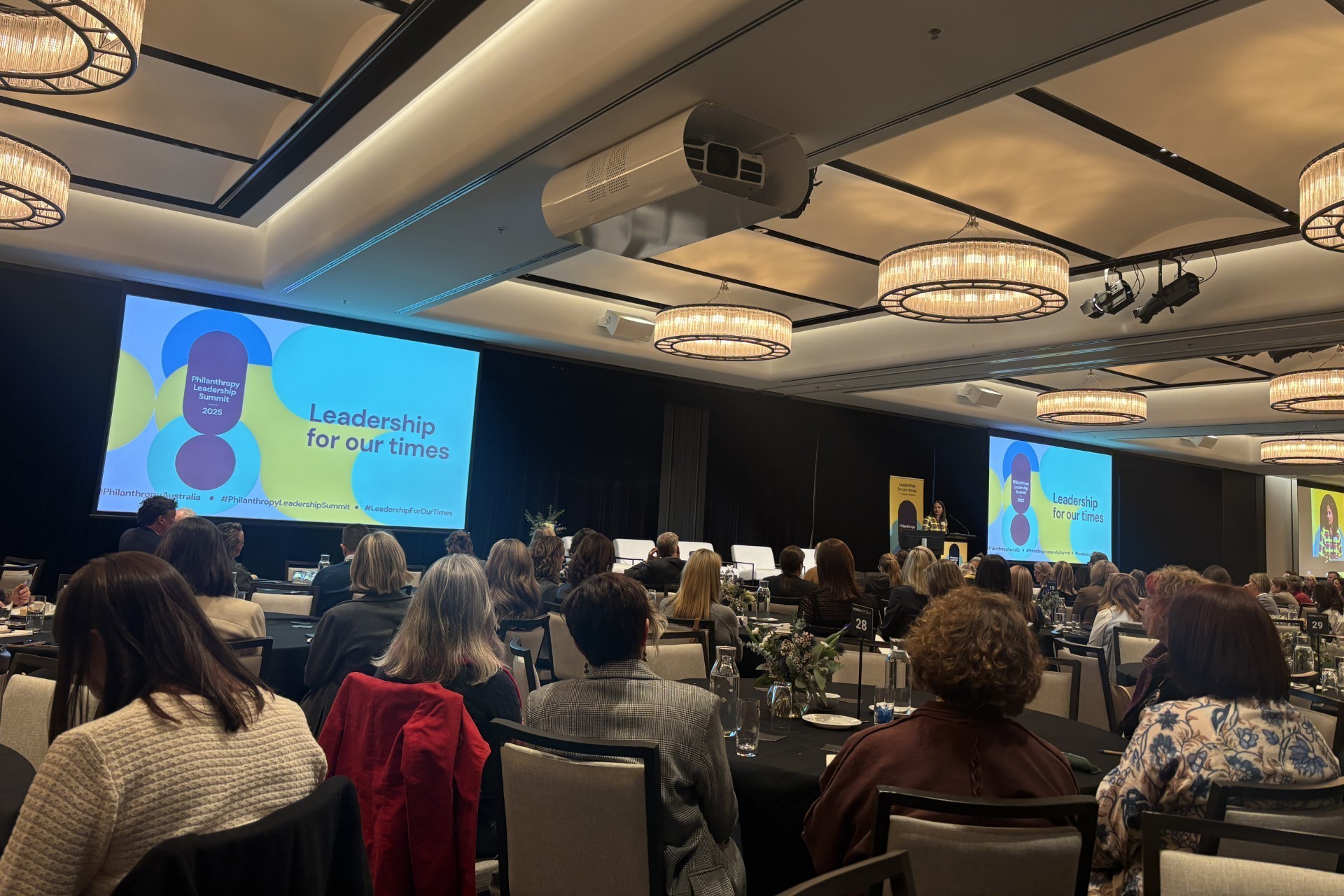
Philanthropy Leadership Summit 2025, hosted by Philanthropy Australia
The inaugural Leadership Summit took place in Canberra. The day started with leadership discussions on the polycrisis and finished (for me, in a breakout session) with economic inequality, and was filled with diverse, challenging and courageous leadership examples across the sector.
And while it is easy to sometimes feel overwhelmed by the events of our world, what is critical to remember is that uncertainty, while it can induce fear, also creates possibility. And possibility creates hope.
So what are the calls to action for leaders in our sector? A summary of top takeaways.
The polycrisis – the interconnectedness of multiple disruptions, inequalities, instabilities and fragilities, which are amplifying one another. The issues, as such, become more complex and the risks greater. The conversation is very much centred on the heart of the definition – the interconnectedness. When issues are linked, the solutions also need to be looked at holistically. The first key trait of leadership? Solving problems. But not in isolation. In fact now, more than ever, the call to action is to come together, to examine the interconnectedness of the issues. Collaboration is key!
For effective collaboration to solve problems, there must be agreement on the issues we are solving. What is the vision and how do we get there?
So too are the facts! False hope is not plausible. Hope has to be facts based, so that the problems to be solved are grounded in evidence. This is still a key area where we observe shortfall of knowledge and information in some for-purpose organisations. Why do you exist? What is the need you are serving? What is the evidence and the facts that support that need? And what is the evidence and facts that exist to prove what sort of solutions may work to help solve the issues causing the problems? What can the future look like? What is actually possible, based on the facts?
Getting comfortable with discomfort
This doesn’t need to be scary. The future is ours to create. Leaders have to get comfortable through collaboration and consultation with stakeholders – especially those who are facing the consequences of unsolved problems. The evidence base does not only come from statistics, as we know, it comes from experiences, conversations and understanding. Are you just turning up, or tuning in? This level of engagement and listening helps to create not just understanding, but trust, which is critical to effectively work together to create change.
Amplify stories of success!
We work in a sector where great happens. Yes, it is driven by need, but for-purpose organisations are drivers of great solutions and changes. I chatted with an organisation that is having trouble engaging program leaders in their awareness and fundraising activities – because they are so busy actually working to solve the problems, and not taking time to celebrate the success. That is, they can’t see the hope they are creating through the solutions they are delivering because they are so entrenched. As leaders, we need to ensure that our teams and future leaders are afforded the opportunity to take time out to really participate in and celebrate the wins, no matter how small.
Have you read the United Nations Universal Declaration of Human Rights?
I am sure in school I did, but it is a good refresher to revisit. In one conversation, it was aptly stated that human rights need to be the centre of policy development and the need for a focus on intersecting rights. But reading and understanding in your head, needs to also be known in your heart, that is, injustices need to be emotionally relatable by people. This is so important in mission driven organisations for forming effective partnerships with funders. The need for your mission and change through impact must be relatable, and evidence based.
Leadership is lonely
I am not sure I agree, or perhaps relate is a better word, to this one. As a natural relationship builder and collaborator, personally, I surround myself with peers and friends in leadership roles, and embark on supporting and building internal leadership. Again, we circle back to sector collaboration!
An important message came through: never assume where you find your allies. To create change, we need to do things differently and the worst thing we can do when change is needed, is to do nothing.
AI – the ‘must include’ on all agendas
As we all know by now, AI is not new. But it is being accelerated into nearly everything we do. I was surprised to learn that, in a 2025 global study of Trust, attitudes and use of AI, Australia comes last in a list of countries, when scoring our emotions of worry, optimism or excitement, towards AI. That is, we are the most worried and least excited! Well, for those with access.
Inequity and the digital divide were a key focus of this discussion and for me, the most pertinent point raised that stood out was AQ, an adaptability quotient, which is the measure of ability to adapt. That is, working with change, and not against it. For the for-purpose sector, which is often risk adverse, it is a risk not investing in AI! There are so many ways for it to improve efficiency and productivity. The time to start is now.
Philanthropy Australia’s leadership in convening so many provocative discussions is commended and left us with some important questions to reflect on…
Do you choose to care? And if so, what are you going to do about it?
What provokes you? What are you going to do?