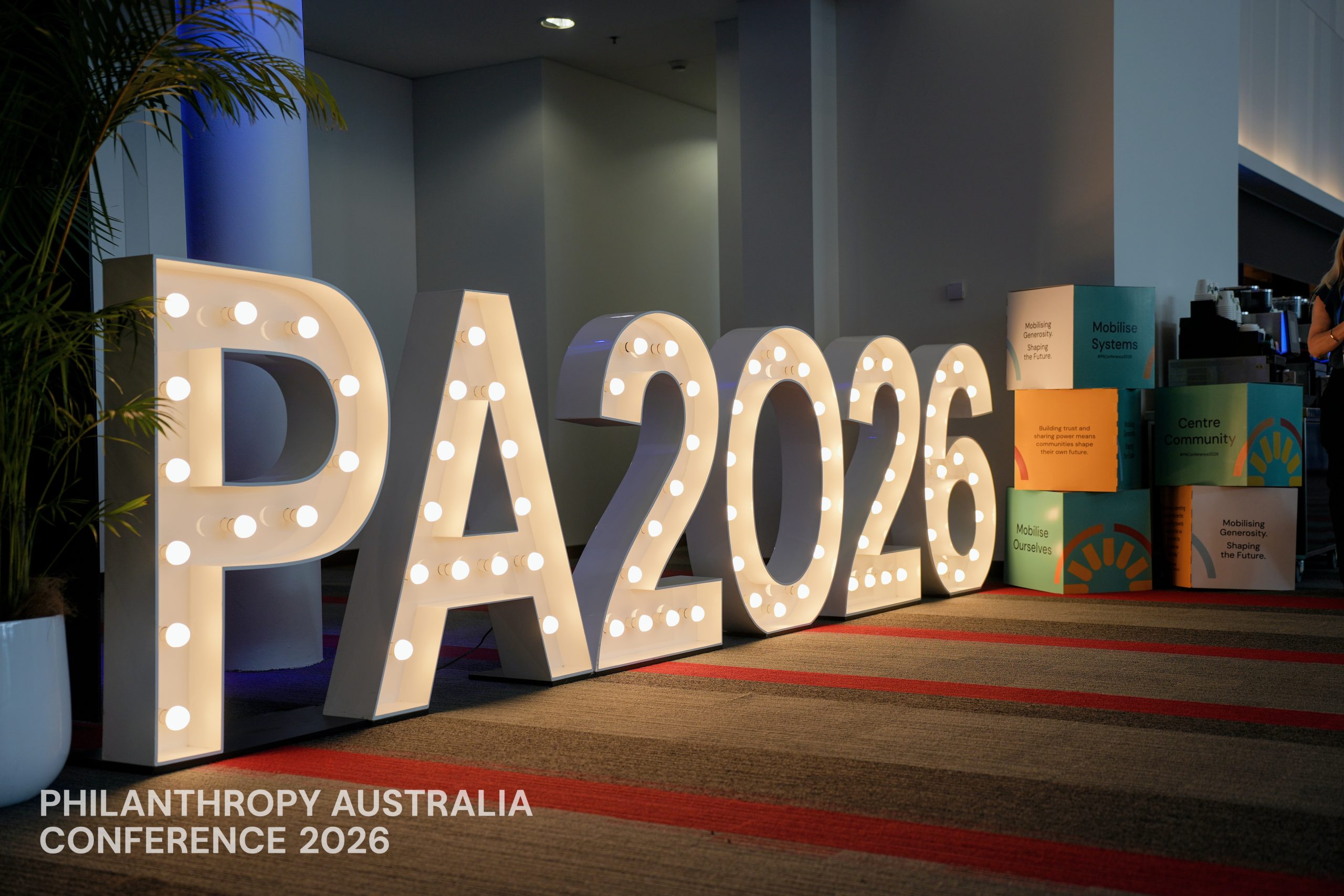
The future of giving: Learnings from the 2026 Philanthropy Australia Conference
With over 1200 community-focused, passionate people from funding bodies, for-purpose organisations and intermediaries in the one location, it’s unsurprising that the 2026 Philanthropy Australia Conference represents an important opportunity for our sector to discuss both individual and collective approaches to giving and to supporting one another.
As just one of the Strategic Grants team in attendance this year, I particularly loved the opportunity to both share—and listen to others—about how trust, culture and collaboration will play an increasingly important role in the future of giving.
I spoke a little on this in the Day 1 Masterclass, where I joined a panel called Inside Philanthropy: Why Successful Partnerships Start from the Inside Out. In the panel (facilitated by Nigel Harris) we explored a deceptively simple question: What makes funding partnerships genuinely successful?
Here are some of the key reflections from my panel and from the wider conference conversations.
Concept 1: Successful partnerships require a culture of philanthropy
One of the strongest themes coming out of the half-day workshop was this:
Successful philanthropic partnerships rarely begin with an application form or a funding request. They begin much earlier, inside the organisation itself.
This means that organisations seeking funding need to understand the philanthropic landscape and the constituencies with whom they hope to build relationships. That includes knowing potential donors’ and funders’ interests, concerns and motivations — but it also means being clear about your own vision, strategy and funding priorities.
Across the PA Conference 2026, there was strong agreement that fundraising success depends on leadership commitment to building a culture of philanthropy.
This “love of humankind” must start inside for-purpose organisations. It starts by building trust and respect within teams that are working together to raise the funding needed to deliver the work – work that fulfills the very reason for an organisation’s existence.
Often, this approach is lacking, however – it is incredibly easy to build. We can begin by creating internal educational events that bring teams together to understand the importance of each other’s role in fulfilling mission delivery. It’s also built through strong internal communication processes -these are key to creating clarity on projects linked to the objectives of a strategic plan.
It may sound simple and logical when spelt out this way, but it is surprising how many organisations face challenges in simply having access to a list of priority funding needs.
Everyone in an organisation should understand what the organisation does, why it matters, and how funding enables its mission. When that internal understanding is weak, the external relationship is weakened too.
Concept 2: Trust is the real currency – and it creates room to learn
The question of how we grow giving in Australia was asked right across the PA Conference 2026.
As always, there are many case studies of funders who have had positive partnerships with charities and unfortunately, there are also always examples of where trust has been broken by the beneficiary not upholding their commitment to spending funds in the way they had said they would.
Strong internal communication, like that described above, makes it easier for staff, leaders and board members to talk confidently and consistently about why funding is needed and how it will be used.
Respect and strategic alignment are essential. Fundraising conversations should not sit apart from organisational strategy; they should be grounded in what the organisation exists to achieve and where a funder’s objectives genuinely align.
In trust-based philanthropy, funders and fund seekers take a learning journey together. This approach creates space for risk, adaptation and honest conversations about what is possible to measure. It also recognises the high value of storytelling and bringing funders closer to the work so they can see what is required at the ground level.
One practical suggestion I saw on one of the funder panels (about ways to reduce reporting burden) was to invite board members, trustees and decision makers from funding organisations to see the work firsthand. That direct engagement can build empathy, deepen understanding and open a more realistic conversation – including about what reporting is useful, proportionate and meaningful.
“For me, the conversations I had and heard at PA Conference 2026 reinforced once more that the strongest philanthropic partnerships are not built around transactions.
They are built around clarity, trust, respect, shared purpose and the willingness to learn together.”
Concept 3: When alignment is missing, don’t try to invent it
Just one of the stories I heard was from a funder who discussed an eight-month process with a potential beneficiary.
The funder was clear about the area they wanted to invest in, yet the organisation returned with a number of different proposals, none of which met the brief.
Rather than acknowledging that the opportunity was not a strategic fit—and potentially referring the funder to another organisation better placed to deliver the work they were seeking to fund—the beneficiary tried to make the funding opportunity fit.
There are some important lessons here. It was acknowledged that both parties could have been clearer from the outset, particularly about the drivers for wanting to invest in a very particular field of work. Setting clearer parameters would have also been value.
For the unsuccessful beneficiary, a lot of time and resourcing would have been saved by asking the right questions when the funder first approached. They could have asked questions like:
Are you committed to only funding that piece of work?
Are you interested in seeing other projects that we are running that are similar?
How flexible is the brief?
Funders face challenges too, and it is important for those seeking funding to understand the complexities that exist within funding structures.
People inside funding organisations often need different kinds of information from reports. This makes clarity essential: funders need to be upfront about the goals of funding, the outcomes they want to understand, and the reporting information that will be genuinely useful.
Others, like corporate foundations, want to understand how their staff can engage in funded projects.
If you cannot easily provide corporate staff with access to your organisation’s work, you may need to reconsider whether these relationships are the right fit — or, at the very least, be clear from the outset about what is and is not possible, and why.”
Concept 4: Innovation does not have to mean new, just better
The topic of innovation was also raised. Refreshingly, AI was not a part of that conversation!
Attendees agreed that we need to focus on the meaning of innovation – not just doing something new – but how are we going to do things better?
For example, how do we celebrate giving?
How do we help donors feel grateful for the opportunity to contribute?
How do we invite them closer to the work, not just the transaction?
Concept 5: Data should drive learning, not just compliance
Impact measurement data should be put to good use beyond satisfying reporting requirements. The bigger question is whether data is informing future strategy, strengthening advocacy, supporting better decisions and helping both parties understand what is changing because of the work.
Success is not always a dramatic transformation. Often, it is positive incremental change — and the learning that comes from changing course along the way.
Concept 6: Giving and belonging are linked
The conversation also turned to a broader question: how do we mobilise giving nationally?
In year two of the CAF World Giving Report Australians rank 38th in the world for how acceptable it is to discuss giving with friends and family… but 87th for how often they actually do it.
We know that wealth does not automatically equal generosity. If we want generosity to grow, we need to better understand why people give and how giving becomes normal, visible and valued.
Giving is the action; generosity is the feeling. The challenge is to cultivate the sense of belonging that makes generosity more likely. Where are we building belonging? Where are we nurturing it? And how can better data help broaden the national conversation about giving?
Concept 7: The strongest partnerships are not transactional
For me, the conversations I had and heard at PA Conference 2026 reinforced once more that the strongest philanthropic partnerships are not built around transactions.
They are built around clarity, trust, respect, shared purpose and the willingness to learn together. If we want more effective giving, stronger funding relationships and better outcomes for communities, we need to start from the inside out.
It’s a wrap
It is fitting to round up some of our key takeaways with some exciting news for Queensland from CEO of Qld Gives, Tara Castle. A new Qld fund for Women and Girls to continue building and strengthening our social infrastructure is being launched!
And from Conference Patron Tim Fairfax AC., “At its heart, this is a story about Australians choosing to give. Choosing to back one another. Choosing optimism over difference. Community over division and a future filled with greater opportunity and hope.”
Well done to the team at Philanthropy Australia for bringing so many change makers together to share and collaborate. Each one of us came away from PA 2026 mobilised to action and re-committed to helping create a sense of belonging in our communities and together helping facilitate the growth of giving in Australia.
About the author

Jo Garner is the CEO & Founder of Strategic Grants. Jo established Strategic Grants in 2009 and in 2012 she launched what is now GEMS – Grants Expertise Management System – New Zealand and Australia’s largest online grant-seeking management system. Jo leads a passionate team of 35, who are all dedicated to working collaboratively with for-purpose organisations to build their capacity and secure grant funding to deliver vital projects to achieve their mission.
With a background in Business, Marketing, IT and Fundraising, Jo’s strong communication skills and ability to apply strategic thinking and solutions to challenges faced by NFPs, has seen Strategic Grants help hundreds of organisations raise funds to deliver their mission through effective funding and engagement strategies.
Jo is a regular presenter at philanthropy and fundraising conferences and is known for her engaging training techniques and facilitation of strategic planning workshops.