The Australian Funding Landscape Is Changing
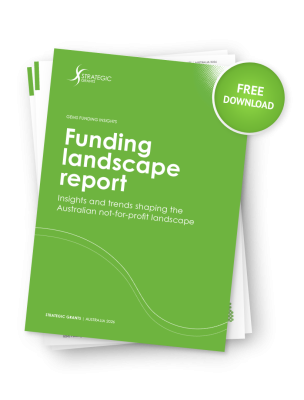
Drawing on funding data from FY21-FY24, this inaugural report explores how funding availability, accessibility and funder behaviour are evolving across Australia.

 $22.5B Available Funding
 ~7,000 Grant Rounds Tracked
 FY21-FY24 Analysis
 Australia-Wide Dataset
Why This Report Matters



What You’ll Learn
✓ Growth and changes in available funding
✓ Government vs philanthropic funding trends
✓ Emerging grant categories
✓ Invite-only funding growth
✓ Funding accessibility trends
✓ Future outlook for funders and grant seekers
Get the full report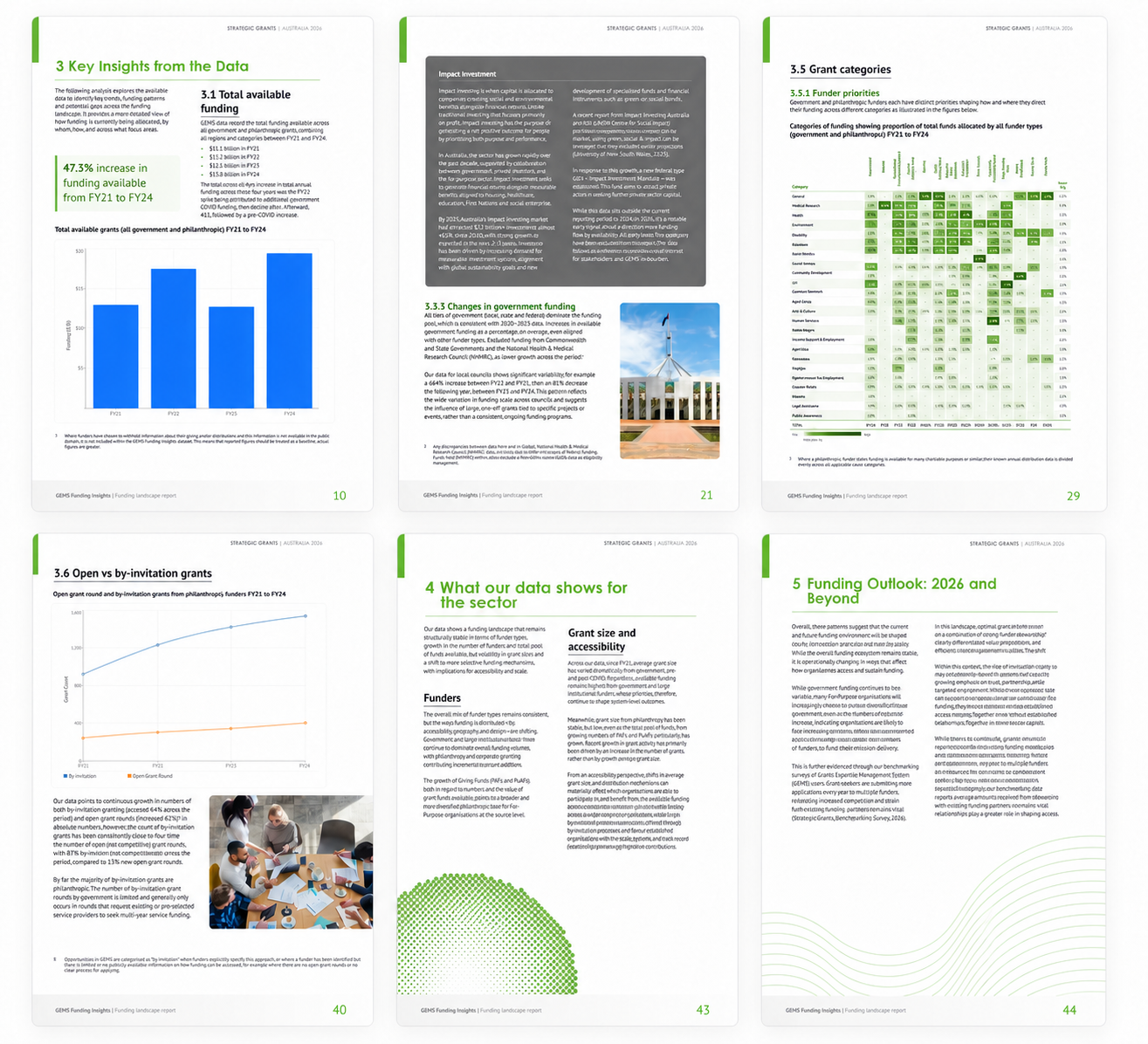
Featured Findings
"*" indicates required fields
Powered By GEMS Funding Insights
GEMS Funding Insights is Australia’s leading funding intelligence platform, powering this report
with the most comprehensive longitudinal funding dataset.

Comprehensive Data
12+ years of funding data across multiple funder types.

Advanced Analysis
Powerful analytics and benchmarking tools.

Trusted by professionals
Used by thousands of funders, advisors and grant seekers.

Live Reporting
Live reports to keep you informed of what’s changing.
Who should read this?




Testimonials
The Strategic Grants white paper was incredibly valuable at a time when I needed reliable insights into the philanthropic landscape across different sectors. I’d struggled to find this information in one place, so when I saw the report… I immediately reviewed it and quickly found exactly what I was looking for.
Stephanie Ah Lam
Manager, Trusts and Foundations
Australian Catholic University
Frequently Asked Questions
FY25 was not used as the core reporting period because the finalised FY25 distribution data was not yet published by the ACNC. Where we are able to find that data from other sources – we include it within live GFI reports, but for the purpose of the white paper – we wanted to match up the remaining ACNC published distribution data we hadn’t yet captured by our research team.
No. The data should not be described as actual money distributed. The dataset records funding that was advertised, intended or otherwise available through grant opportunities.
Where available – we will apply known distribution data, or reported total amounts against specific grants, instead of using the intended range.
For Funders which report to ACNC, with multiple grants- we apply that reportable amount across all grants in a ratio of their advertised size – such that the total grants value is never greater than their reported amount for any Financial Year, and each amount per grant is likely closer to the actual amount distributed than initially advertised.
Funding may sit outside the reported dataset where information is not publicly available, not supplied by funders, or not coded in a way that supports reporting.
This may include:
- Private funders with limited public information.
- Funders without clear category, geography or grant coding.
- Grants that were never publicly available – even if we knew they existed.
- Funding where the intended geography or cause area is unclear.
- Funding by international funders where the geographic region is not solely AUS or NZ
- Some historic or incomplete records where data quality is insufficient for reporting.
GFI uses algorithms and allocation logic to estimate reported distributions across category or geography splits and relies on the law of large numbers to provide estimated trends across these.
Government and non-government funding behave differently, and several draft discussions identified this split as essential. Separating government and philanthropic funding helps avoid large government programs masking trends in philanthropy, corporate giving, community foundations, PAFs, PuAFs and other funder groups.
In General, Government funding dwarfs philanthropic funding in most categories to such an extent that any reporting which includes government and philanthropy – is essentially just reporting on government giving.
Some AI was used to help generate code and scripts. Those scripts were then used to produce some of the graphs and tables. All the code was human verified and run locally. None of the GEMS data was given to an AI to analyse. The White Paper writing was all done by the talented human team at Strategic Grants.
Yes, we will be providing access to specific reports assessed and quoted on a case-by-case basis.
Ready to Understand What’s Changing in Funding?
Download the inaugural GEMS Funding Insights White Paper and explore the trends shaping Australia's funding landscape.
Download the Report Learn More About GFI