
The Perpetual 2027 IMPACT Philanthropy Application Program (IPAP) opens on Wednesday 4 November 2026 and closes on Friday 4 December 2026.
If your organisation is considering a Perpetual 2027 IPAP application, start now. You will need time to confirm eligibility and project fit, gather evidence of organisational governance and capability, and coordinate input from relevant staff and Board members.
Remember, Perpetual’s assessment focuses on four pillars when assessing IPAP applications: Strategy, Leadership, Capability and Outcomes. Keep this in mind when identifying which KPIs to include and which project to apply for.
We encourage organisations considering an IPAP application to take the following steps:
- Attend the Perpetual 2027 IPAP Webinar hosted by Fundraising Institute Australasia (FIA) on 20 October. If you cannot attend, we encourage you to watch this How To video on the IPAP website (scroll down, you’ll see it). This video is useful because it includes information about the key assessable questions within the application.
- Review last year’s IPAP Guidelines, FAQs and Sample Application Form on the IPAP webpage (about halfway down). The 2027 IPAP documents will be available on the Perpetual website in the coming weeks – so keep an eye on the IPAP webpage or register to receive those updates. Use these documents to confirm eligibility, strong project alignment and that you have sufficient information to prepare a robust application.
- IPAP may not be the right opportunity for every organisation. Before committing time and resources, confirm that your organisation is ready with credible evidence of the capabilities and competencies assessed. The IPAP round is competitive: in 2025, 17% of applications were successful.
A checklist for preparing your Perpetual 2027 IPAP application
Check 1: Is your mission statement consistent?
Check that your mission statement is consistent across your external communications (website, social media, published documents, etc) as well as your IPAP application.
Check 2: Ensure your KPI answers are specific
KPI questions are often answered too generally. Perpetual’s assessment guidance explains why each question is asked, what information a strong response should contain, where that information may be held and who within your organisation can provide it. Review this guidance before drafting your response.
Remember, your Key Performance Indicators need to be specific. If you are struggling to formulate KPIs, think SMART:

Efficiency KPIs relate to how well your organisation uses its resources, including financial, human, time, technology and operational resources.
Efficiencies generally relate to quantifiable measures and may include:
- Growth/reductions in income and expenses
- Diversification/growth of revenue streams
- Staff retention
- Number of occasions of service delivery to target group/cause
- Other operating efficiencies across areas of the organisation.
Effectiveness KPIs show how well your organisation is progressing its mission by measuring the changes or benefits created through its work.
This information is likely to be found in your strategy documents, program logic, and monitoring and evaluation frameworks. Effectiveness KPIs may include:
- Increased participation, awareness, etc.
- Changes in behaviour, understanding and attitudes
- Improvements in conditions
- Systemic changes.
Clearly explain how you are performing against your KPIs
Use data and evaluation findings to explain performance against each KPI you list. Combine quantitative evidence, such as financial results, service delivery figures and percentage change, with qualitative evidence from staff, volunteers and clients.
Perpetual does not assess whether your organisation has achieved every KPI; it assesses whether you monitor and understand performance. If results have declined or increased significantly in any area, briefly explain the contributing factors.
Tip: Provide year on year data to show tracking and performance over time.
Check 3: Explaining external challenges
The external challenges question relates to issues affecting your sector, demonstrating that your organisation understands the factors outside its control that may affect its ability to achieve outcomes and pursue its mission. These factors often fit into one of the following categories: political, economic, social, technological, legal or environmental.
Tip: Do not include challenges relating to fundraising or revenue (or lack thereof); Perpetual understands this is a sector wide challenge.
Check 4: Explaining organisational risks
All organisations face risks: Perpetual wants to know that your organisation has identified risks to its operations and longevity and is actively working to mitigate and manage them. You must highlight at least three risks and mitigation strategies in your answer.
Tip: Refer to your organisation’s Risk Register and/or Board reports for this information.
Check 5: Align your request to your strategic priorities
The project you are requesting funding for should align with your organisation’s strategic priorities for 2027-2028 FY (a question about your organisation’s strategic priorities is asked earlier in the Organisation section of the application).
Check 6: Build a strong Project Description
In the Project Description, establish the project’s need and rationale with relevant, current evidence. This may include statistics, ABS data or your organisation’s evaluation findings. Explain what each source demonstrates, connect the evidence directly to the proposed response, and reference every source so assessors can verify the basis of your claims.
Check 7: Nail the Project Outcomes question
Project Outcomes. Outcomes and outputs are often confused in grant applications, and this can impede a successful outcome.
The outcomes question is the key assessable question in the project section of the application. Ensure your answer describes the changes that will occur through the delivery of the project’s activities and outputs, and include indicators and measurement tools for each outcome.
Remember:
Outputs are the direct products of project activities, such as the number of sessions delivered, occasions of service, resources produced or items purchased.
Outcomes are the changes or benefits that result from project activities and outputs, such as changes in participants’ knowledge, behaviour, skills, wellbeing or circumstances.
Check 8. Ensure your project timing meets the criteria
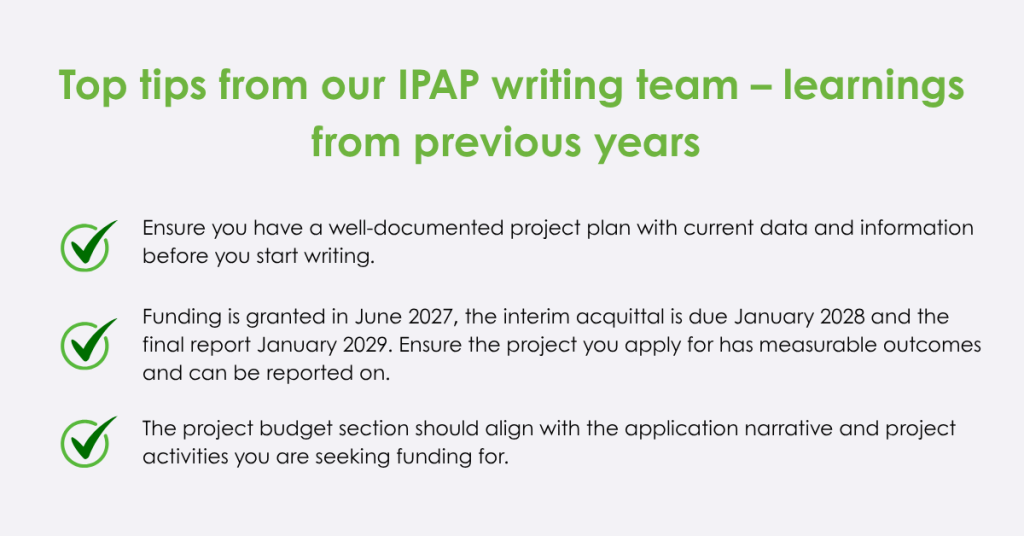
Make sure your project does not start before the Perpetual grant distribution date, i.e the earliest date your project can start is July 2027.
Check 9: Be clear about budgets and requested amounts
Do not request more than the maximum amount specified in the current IPAP guidelines. Note that the average grant amount distributed over the last couple of years has been $78,000 – $80,000. Build each expenditure item from verifiable assumptions, using supplier quotes, confirmed wage rates and documented unit costs wherever possible. Avoid unexplained round figures, as they may appear estimated rather than accurately costed. Check that total income equals total expenditure and that the budget matches the activities described in the application.
Check 10: Know the limitations of AI
If you use generative AI to support drafting, treat its output as a starting point rather than a final response. Check every statement, figure and source against authoritative information; remove confidential, personal or client-identifying information; and ensure the final application accurately reflects your organisation’s own evidence, experience and voice.
Helpful resources for your Perpetual 2027 IPAP application
- Perpetual’s IPAP Assessment Guidance section on the IPAP webpage provides invaluable advice on how to address assessable questions.
- Perpetual’s ‘A decade of philanthropy’ report provides some useful insights into IPAP distribution trends over the period 2015-2024 https://www.perpetual.com.au/insights/insights-from-decade-philanthropy/
- Strategic Grants’ blog, Gender Lens question – Applying a gender lens to grant applications (and why we should).
- Strategic Grants’ blog, Outcomes vs Outputs – The ins and outs of outcomes and outputs: getting it right in your grant applications
If you would like support preparing your 2027 IPAP application/s, please reach out to the Strategic Grants team by Friday 23 October 2026.

Michaela Chilcott is a Grants Strategist at Strategic Grants, based in Queensland. She has over a decade’s experience in the for-purpose sector, working across multiple fundraising disciplines for national and Queensland-based charities.
At Strategic Grants, Michaela works with for-purpose organisations to strengthen their grants readiness and embed grants best practices that combine robust impact evidence with meaningful funder engagement.
Michaela’s broad range of fundraising experience provides her with the experience and tools to guide for-purpose organisations through the grant-seeking process and set them up for funding success.